
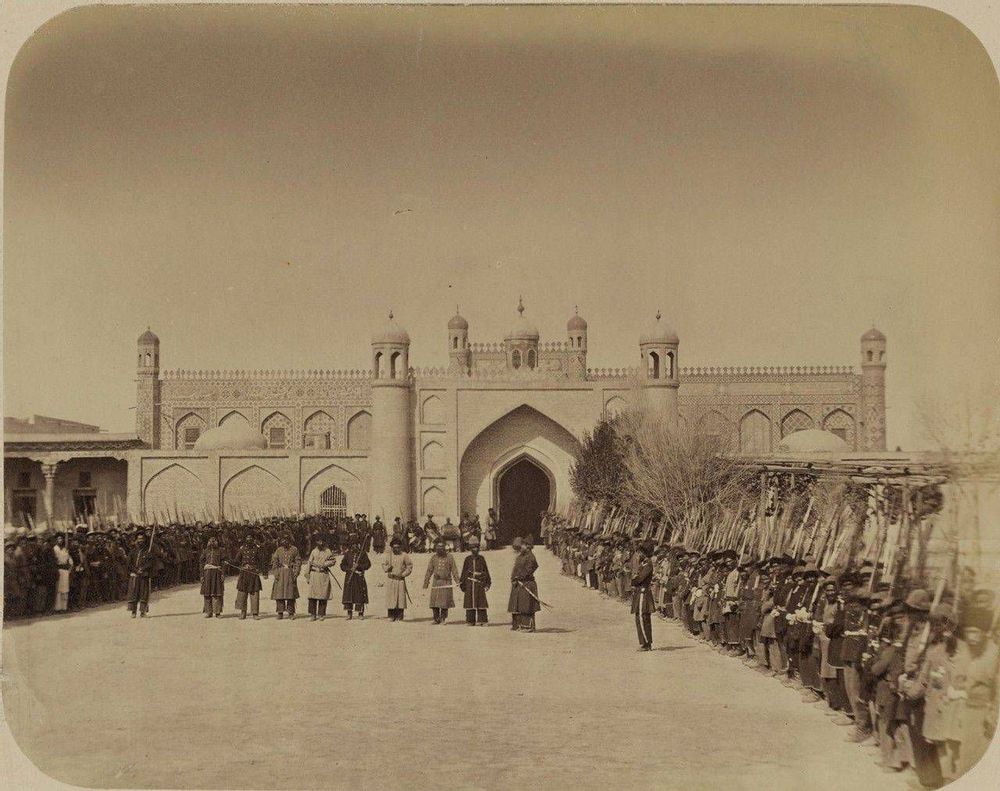
In order to ensure the peace and tranquility of the country and to prevent crime, the activity of shikhna was established in the state of Khorezmshahs. They also performed the task of punishment with their squads. Usually, commanders of the Turkic people - emirs - were appointed to the position of shikhna. If anyone poses a threat to the government, wants to start the people against the existing system, the Shikhna immediately identifies him and punishes him accordingly.
In the state of Amir Temur, there was a special guard unit in the army camp, which was placed for the night and as a camp during military campaigns. This unit is located half a farsakh away from the headquarters of the troops, and special posts are placed in front. The guards were in regular contact with each other and delivered information about the enemy to the headquarters. The settlement itself also had special guards, who were responsible for maintaining order, controlling trade and food prices, and preventing possible theft.
By the 16th - 18th centuries, three independent states - Bukhara Khanate (an emirate from the middle of the 18th century), Khiva and Ko'kan khanates were formed in place of the Timurid kingdom. The state administration in them is similar to each other, and the administration procedure during the Timurid and Shaibani eras has been kept almost unchanged. State administration, finance, court, mirshab and military affairs were managed by the ruler's relatives and people close to him. They have great rights and privileges in performing their activities.
During this period, there were such positions as shaykhulislam, mufti, alam, qazi, muhtasib (chairman), kokaldosh, daruga, dodkhoh, and yasavul. They were responsible for the observance of religious and Sharia rules, the fulfillment of the criteria of justice, the correctness of the scales in the markets, the control of national security, conducting investigations and collecting taxes.
Mirshabs were considered responsible for the peace and tranquility of the population. The word Mirshab (Arabic: mir - ruler, shab - night) was used in Central Asian khanates in the sense of an administrative position, night watchman and their chief. Mirshabs guarded cities and villages day and night, ensured order in public places, markets and streets. They are also responsible for the execution of the punishment imposed by the judges (court) for the crime.
Criminal and penal cases were decided on the basis of Sharia laws, for example: for the crime of theft, the thief was forced to return the property to its owner and compensate for the damage, in some cases, that is, when he committed a repeat theft, his hand was cut off. When the crime of murder was committed, according to Sharia rules, the rule of "revenge" was followed. That is, the family of the victim had the right to choose whether to punish the murderer (death) or receive "diya" (payment). Invasion and sedition are punishable by death or exile.
When the wars ended, the part of the army that was not sent home was temporarily subordinated to the mirshaboshis to perform tasks aimed at ensuring the security of the rulers, peace in the cities and villages, fighting against thefts and other crimes. During the peacetime, the soldiers were mainly engaged in mirshab, construction of roads and bridges for military purposes, construction of new fortifications, repair of old ones, construction of houses and dormitories for the soldiers.
During the Khiva Khanate, the mirshabs strictly obeyed the rules of the state and sharia. Their main task would be to guard the Ichan-Qala, to execute the prescribed punishments according to the judge's verdict. According to archive documents, a total of 29 mirshabs served at the Pahlavon gate, Sheikh gate, Mahmud ata gate, Khizr baba gate in Khiva.
The city of Bukhara occupies a special place in the central state administration of the Emirate of Bukhara. In particular, the mayor (koshbegi) of this city was considered the first minister of the emir and the manager of other regions. Mirshabs are responsible for maintaining public order in the city. They obeyed the city mirshhaboshi. The mirshabboshi of the city of Bukhara obeyed, as well as the mirshabboshi of all other cities.
During the rule of the Mangits, in Bukhara the koshbegi, qazikalon, chief chairman and mirshabboshi were jointly called "chor hokim", i.e. "four hokims".Among the executive positions in the Emir's palace were the mirshabboshi responsible for city security and his subordinates, the mirab responsible for water supply and his subordinates. Mirshabboshi was also subordinated to yasovulbashi, devanbegi, mahramboshi, mirzas, dahboshi, shabgard (evening watchman), farroshbashi.
In our people, prying eyes on other people's property and stealing have been strictly condemned since time immemorial. Those who committed the rare crimes of beating scales, theft, adultery and other similar crimes were publicly punished. For example, according to the sources, a seller who betrayed the rights of the buyer in the markets of Bukhara was shown half-naked in a cart to the market people and was forced to shout at the top of his voice: "I entered the path of the devil and cheated the buyer." Such measures of influence served as a kind of "prevention" and were a way of curbing crime.
Elders of each neighborhood and street were elected by the population. Various family disputes and quarrels between neighbors were resolved by these elders on the spot. Everyone was obliged to accept and fulfill the verdict issued by them. Mirshabs and Qazis intervened in the conflict only in difficult situations where this was impossible.
Anvar Kandakharov,
philosophy of history
doctor (PhD), associate professor.
Asliddin BEGBOYEV,
lieutenant colonel