
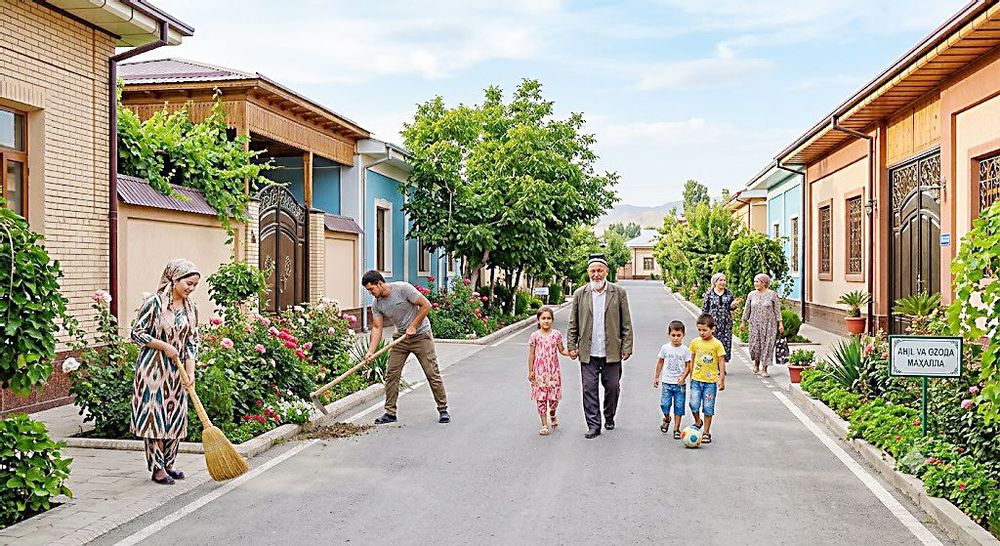
In this regard, at the meeting of the video selector held last week in the presence of the head of our state, it was specially noted that this year, in order to improve the infrastructure and create conditions for people and entrepreneurs, districts were allocated 250 billion soums and 5.5 billion soums were allocated to neighborhoods.
It was specially noted that the system created to curb crime in the neighborhoods is giving its results, that no crime was committed in 571 out of 1,162 neighborhoods with a severe criminogenic situation in the last three years, this was achieved as a result of installing video cameras, organizing safe streets and corridors, solving population problems on a scientific basis, and providing psychological support to families.
The President's recent visit to the neighborhood of "O'zhalish" in the Sergeli district of Tashkent city, and the tasks he gave to turn each neighborhood into a safe place, a peaceful area, became a unique new program for the work to be carried out in this direction. During the visit, clear instructions were given on how to create a safe and prosperous neighborhood.
The decree of the head of our state dated June 24, 2026 "On additional measures for the effective organization of neighborhood management" became an important legal basis for turning the neighborhood into a real "bridge" between the people and the state, and creating a safe neighborhood.
"Safe neighborhood" means an area where the peaceful and peaceful life of the population is ensured, crime prevention is systematically implemented, and state organizations and public cooperation are effectively organized.
In the decree, the tasks of the members of the "seven" were defined clearly and clearly, and it created a great opportunity for each person in charge to work in his own direction. Now the chairman not only coordinates the work of the members of the "seven", but also acts as a strategic leader who unites them around a single goal. He deeply studies the existing opportunities in the neighborhood, the needs of the population, the specific characteristics and problems of the area, and sets priority strategic tasks based on them.
According to the decree, deputy mayors act as general managers for the development of the neighborhood economy. Their main task is to use the economic potential of the neighborhood, create new jobs, increase the income of the population and reduce poverty. Their activity is evaluated by the growth of the population's income.
At the video selector meeting, it was noted that as a result of reducing the workload of prevention inspectors, crimes in some neighborhoods have decreased from 10 to 5, and the task of implementing this experiment fully in Namangan region by the end of the year, and in 448 neighborhoods with a severe criminogenic situation in the rest of the regions.
Now, they are not only an employee who takes action after a crime has been committed, but they are one of the main officials who prevent crime in the neighborhood, analyze the criminogenic situation, identify risk factors early, and coordinate the activities of state bodies and public structures.
The prevention inspector constantly analyzes many factors, such as the social situation in the neighborhood, problems in families, negative situations among young people, domestic conflicts, unemployment, indebtedness, and leaving out of education, and plans preventive measures based on these analyzes.
A methodology will be developed based on the experience of exemplary neighborhoods together with scientific organizations responsible for curbing crime. Throughout the year, prevention inspectors of "red" and "yellow" neighborhoods are trained on this method.
Now, women's activists are the main defenders of family stability and women's interests, who are the first to identify and help solve problems such as family conflicts, the risk of divorce, unemployment, alimony, early marriage, migration, difficult upbringing of girls, oppression and violence.
As a "leader of youth - a leader responsible for the destiny of every young person", he implements projects aimed at increasing self-confidence of young people, serving useful and national interests for society.Organizes activities aimed at realizing their personal development, talent and talent.
From now on, the neighborhood tax inspector will not be limited only to the area of tax work. Assesses the economic potential of the neighborhood, identifies available reserves. Deeply studies and analyzes the economic situation.
In particular, all employees working in enterprises located in the territory of the neighborhood will be examined for their presence in tax reports and will monitor their legal activities.
Social protection workers provide professional social services based on a complex approach directly at the neighborhood level to individuals and families who are in a serious situation and at high risk of falling into a serious situation.
Another important aspect of the decree is that now each member of the seven is not limited to his own direction, but is jointly responsible for the overall result in the neighborhood.
Performance evaluation also focuses on the result rather than the process. That is, whether unemployment in the neighborhood has decreased, whether new jobs have been created, whether poverty has been reduced, whether crimes have been prevented, whether residents' appeals have been resolved in a timely manner - these indicators will become the main criteria.
Shuhrat ROZIYEV,
our own reporter.