
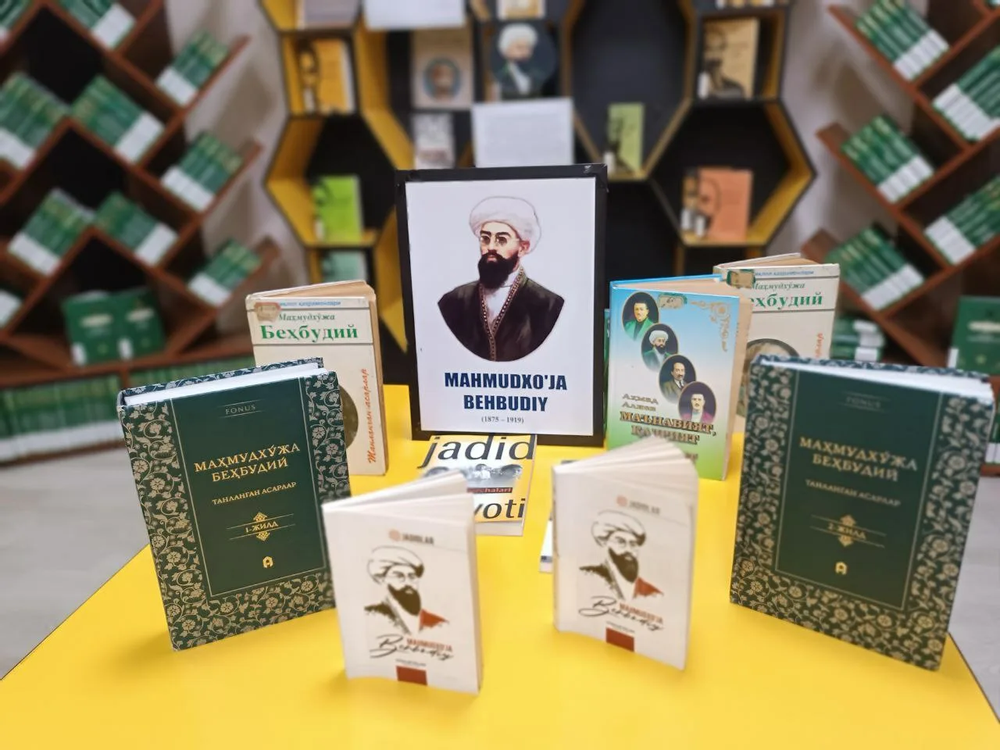
Mahmudhoja Behbudi was born on January 19, 1875 in the village of Bakhshitepa near Samarkand. His father, Behbudkhoja Salihkhoja, was a descendant of Ahmad Yassavi's son, who served as imam. His maternal grandfather, Niyozhoja, was from Urganch and came to Samarkand during the reign of Bukhara emir Shahmurad (1785-1800). After the death of his father, Mahmudhoja grew up under the care and education of his uncle, Qazi Muhammad Siddiq.
In 1903, on the initiative of the scholar, his students Siddiqi Ajziy Halvoyi, Abduqadir Shakuriy opened modern schools in Rajabamin village, Haji Muin Khoja Nisbatdar neighborhood.
In 1908, Behbudi opened the library "Kiraatkhanayi Behbudiya" (later known as "Behbudiya"). Alloma writes in the article "Samarkand library Islamiyasi" that the library has 600 books and pamphlets, and even more newspapers and magazines.
During his trip in 1914, he visited various cities in the Caucasus, Crimea, Turkey, Greece, Bulgaria, Austria, and Germany, from where he brought a lot of books and pamphlets for his library.
Mahmudhoja Behbudi started press work in 1913, and in April of this year "Samarkand" newspaper and in August "Oyina" magazine began to be published. "Samarkand" newspaper is published in Uzbek and Tajik languages, twice a week, first two, then four pages.
Among the intellectuals of the Behbudi nation, Abdurauf Fitrat, Siddiqi, Haji Muin, Akobir Shomansur, Muhammad Said, Saidrizo Alizoda, Saidahmad Vasli, Tavallo, Sadriddin Ainiy, Hakim Bukhari, Niyazi Rajabzoda publish articles and poems on the pages of "Oyina". It is known that the publication served as an experimental field for young writers, future writers and intellectuals.
Alloma founded the National Theater in 1914 in order to encourage the people to progress by showing the vices, defects and ignorance in the life of the society. He writes the drama "Padarkush" for performance on the stage of the theater. "Padarkush" was first staged in Samarkand on January 15, 1914, and in Tashkent on February 27, 1914.
Scientific and literary heritage Behbudi wrote textbooks and manuals such as "Risolai azrefi Savad" (1904), "Risolai geografiyai Umroni" (1905), "Risolai geografiyi Rusiy" (1905), "Kitobat ul-atfol" (1908), "Amaliyoti Islam" (1908), "History of Islam" (1909). In addition, many articles were published in "Gazette of Turkistan region", "Tujjor", "Samarkand" newspapers and "Oyina" magazine.
After the independence of Uzbekistan, the blessed name of Mahmudhoja Behbudi, like all our ancestors, was revived. Historians and linguists began to study his socio-political activity and scientific heritage.